
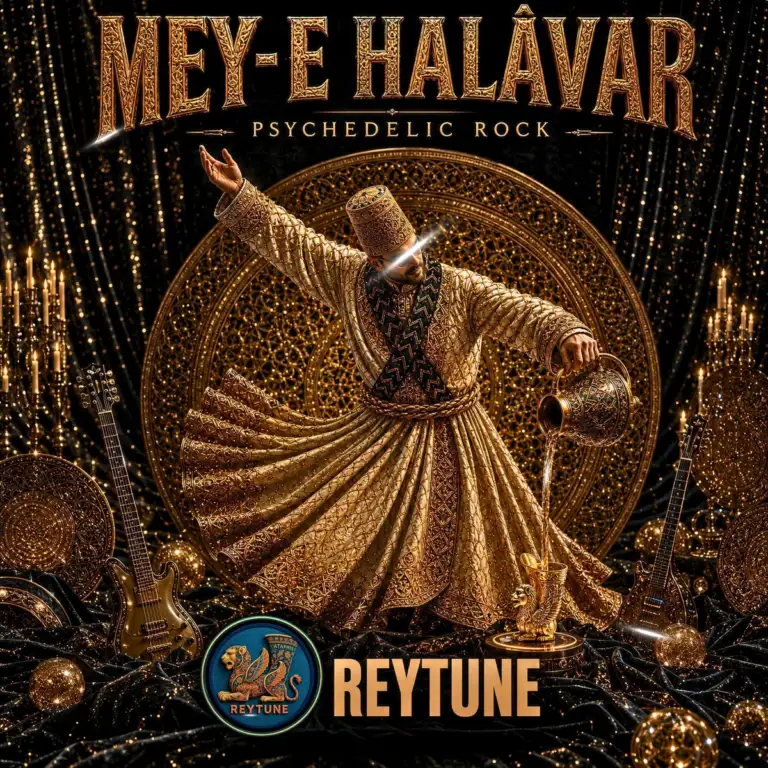
Mey-e Halâvar — ReyTune cover art
Single · Released June 15, 2026

Mey-e Halâvar

Afshārī-rooted instrumental Persian psychedelic and progressive rock uniting quarter-tone electric guitar phrasing with atmospheric synthesizer architecture and electronic programming (featuring Majid Zeidabadinejad) over cinematic rock dynamics.

Persian Psychedelic Rock Āvāz-e Afshārī Duration · 03:59 Featuring Majid Zeidabadinejad

Interactive Stream & Modal Architecture
Mey-e Halâvar (feat. Majid Zeidabadinejad) cover art
Spotify Interactive Player
Mey-e Halâvar (feat. Majid Zeidabadinejad)
ReyTune · 03:59 · Click to Load Player
Release Date
June 15, 2026
Modal System
Āvāz-e Afshārī (Persian Dastgāh)
Duration & Format
03:59 · 24-Bit Stereo Master
Credits
ReyTune feat. Majid Zeidabadinejad (Synth & Electronic Programming)

Where Āvāz-e Afshārī Modal Phrasing Meets Heavy Rock Dynamics

Mey-e Halâvar bridges the contemplative intervals of Persian Āvāz-e Afshārī with modern progressive rock production. Rather than treating traditional modal phrasing as a decorative ornament, the fully instrumental arrangement builds its harmonic tension, synthesizer textures, and electric guitar sustain around the expressive contour of the Afshārī mode.

For listeners exploring how Persian rhythmic cycles and microtonal phrasing translate into contemporary studio rock, read our connected essay Four Strokes into the Future: Chaharmezrab, Reng & Tarab.

Release Notes & FAQ

What is the musical foundation of Mey-e Halâvar?
It is an instrumental studio single built on the intervals of Persian Āvāz-e Afshārī, pairing ReyTune’s quarter-tone electric guitar overdrive and bass groove with synthesizer textures and electronic programming featuring Majid Zeidabadinejad.
Where can I stream the verified official release?
Stream directly on Spotify and Apple Music.
How does Mey-e Halâvar connect to the 44-minute album MEHRĀZI?
Mey-e Halâvar established the Afshārī harmonic palette that later expands into Movement IV (Three Steps Beyond the Wall, Āvāz-e Afshārī · Gūsheh Hesār) on the 12-movement symphonic opus MEHRĀZI.