Rhythmic Deep Dive
Four Strokes into the Future: Chaharmezrab, Reng, Tarab, and Persian Psychedelic AI
Why begin with rhythm?
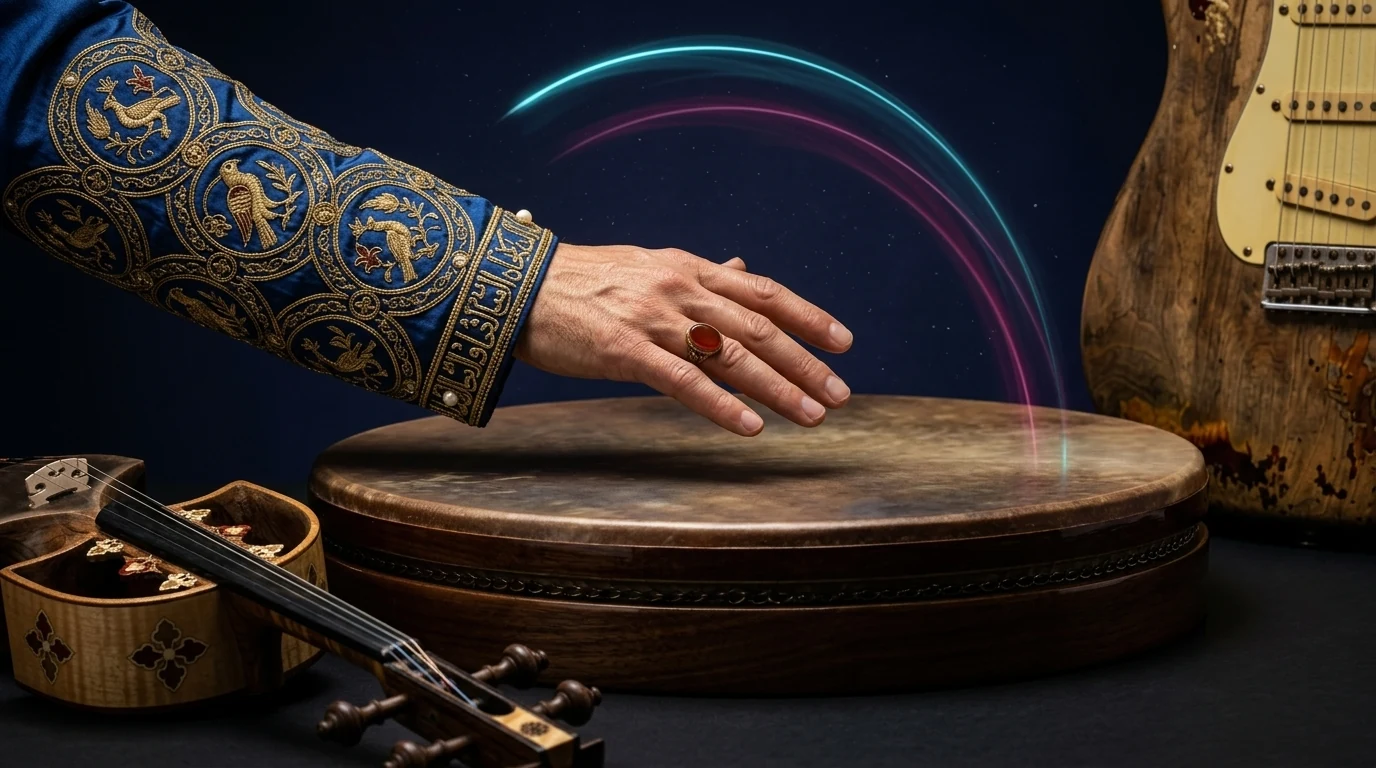
ReyTune’s first article asked what makes a Persian-rooted psychedelic rock language more than a Western riff with an “Eastern” surface. The answer was structural: modal behaviour, inflection, repetition, timbral transformation and a convincing return. The second article asked what artificial intelligence can actually understand in Persian music. Its answer was deliberately narrower: systems can model patterns and generate plausible local continuations, but cultural meaning, lineage, tarab and performance judgement remain human responsibilities.
This third article brings those questions down to the level of motion. Before a new track becomes a cloud of synths, a distorted guitar or a cinematic desert image, it needs a way to move. Chaharmezrab and reng offer two different answers. One drives the body forward through repeated, articulated strokes. The other opens the music outward into lightness, social lift and release.
What is chaharmezrab?
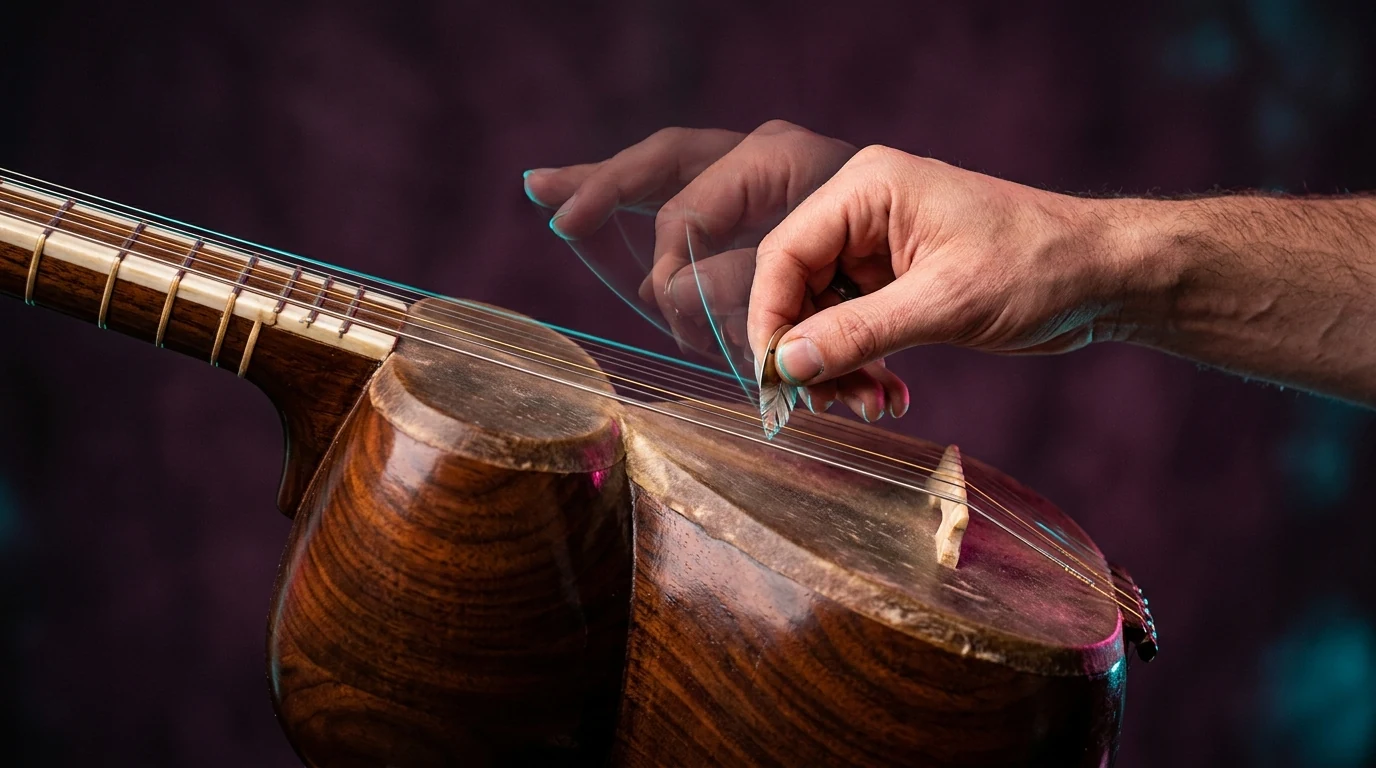
Chaharmezrab—also written chahār-meżrāb or chahārmezrāb—literally points toward four plectrum strokes. Encyclopaedia Iranica describes it as a traditional rhythmic instrumental genre whose name suggests a pattern of right- and left-hand plectrum movements. In older practice, its formulas were associated especially with fast tempos and a common 6/16 type, but the form has evolved across tar, setar and santur, and has also been adapted for bowed and wind instruments. (Encyclopaedia Iranica: Čahārmeżrāb)
The important point is that chaharmezrab is not a scale and not a fixed loop. It is a way of organising attack, repetition, melodic return and technical energy. A recurring cell gives the listener a floor. Small changes in register, accent, ornament or modal emphasis turn that floor into a path.
In the conventional architecture of a dastgah performance, chaharmezrab commonly appears near the beginning or around the entrance to an important melodic area. It can relieve the tension of non-metric avaz, introduce the tones of a mode, and display the performer’s control before the music opens into more elastic development. It is therefore both a kinetic statement and a navigational device.
The four forces inside a chaharmezrab
Stroke
Attack, articulation and the physical intelligence of the plectrum or its modern analogue.
Cell
A short repeated rhythmic-melodic unit that creates recognition without requiring a Western chord loop.
Return
A modal landing or re-centering that makes acceleration feel purposeful rather than random.
Display
Virtuosity, variation and controlled density: technique becomes part of the composition.
ReyTune editorial model: the form can be transformed, but its motion should remain audible.
What should a listener hear?
- The engine: a repeated pattern that establishes physical momentum.
- The contour: a melody that does more than run up and down a scale.
- The pressure: accents, density and speed that make the return feel earned.
- The release: a landing that reconnects motion to a modal centre.
For a ReyTune arrangement, electric guitar, bass, drum kit, tanbur-like plucks, santur samples or a synthesizer can carry these responsibilities. The instrument can change; the relationship among attack, repetition, contour and return is the part that must survive.
What is reng?
Reng is a composed rhythmic piece, ordinarily of light character and associated with dance music. In the classical performance sequence it is commonly heard as a concluding form, after the more exploratory and vocal sections. The association with dance matters, but it needs precision: the concert form is not simply a soundtrack for a dance floor, and “light” does not mean emotionally shallow. (Encyclopaedia Iranica: Iran xi. Music; Center for Iranian Music terminology)
Reng changes the social temperature of a performance. It gathers what came before into a clearer pulse, a more immediate phrase and a sense that the listener’s body is allowed to participate. In a psychedelic setting, that quality can become the moment when a long modal journey turns outward: the bass locks in, the percussion becomes legible, the repeated phrase brightens, and the room feels larger because everyone can feel where the beat is.
We should resist translating reng as “joyful Persian music” in the abstract. Its energy is specific to the composition, mode, meter, ensemble and performance. One reng may feel celebratory; another may feel elegant, mischievous, ceremonial or bittersweet. The category gives us a family resemblance, not a single emotional command.
Tarab: why joy is not just a mood
Tarab is often described across Middle Eastern musical discourse as musical ecstasy, intense aesthetic feeling or a heightened state of listening. In Persian sources and poetry, the word can evoke an enthusiastic, this-worldly pleasure in hearing music; Persian musicians also discuss the related but distinct idea of hāl, an aesthetic and emotional state tied to musical effect and authenticity. These terms should not be collapsed into a button marked happy. Here, ReyTune uses tarab cautiously for an experience shaped by timing, repetition, timbre, melodic emphasis, performer responsiveness, audience memory and the social situation. (Encyclopaedia Iranica: Hafez and Music; Encyclopaedia Iranica: Hāl)
AI can model acoustic correlates of intensity, but tarab is not reducible to a single feature. It is an emergent relationship among performer, audience, memory and moment.
This is where chaharmezrab and reng meet. Chaharmezrab can concentrate attention through speed, precision and anticipation. Reng can make that concentrated energy shareable. Tarab is the possibility that appears when the music’s formal motion becomes humanly felt.
For ReyTune, the production question is therefore not “How do we make this track sound happy?” It is: what sequence of expectation, resistance, return and release could make the listener want to move?
A Persian energy arc: from arrival to release
| Energy stage | Traditional reference | Contemporary production question |
|---|---|---|
| Arrival | Opening orientation, drone or modal centre | What tone, texture or silence tells the listener where the piece lives? |
| Ignition | Chaharmezrab-like rhythmic articulation | Which stroke cell becomes the track’s physical engine? |
| Expansion | Melodic development and modal navigation | How can repetition change through register, inflection, density and space? |
| Release | Reng-like lightness and composed pulse | When does the music become communal without becoming generic? |
| Return | Cadential or modal re-centering | What makes the final landing feel like memory rather than a hard stop? |
This is not a claim that every classical performance follows one universal script. It is a ReyTune arrangement model: a way to preserve the idea that rhythm can carry a listener through states rather than simply decorate a loop.
Reference listening: names worth following
The following are listening references, not a definitive ranking. Titles, attributions and performance traditions can vary, so each example should be checked against the cited recording or catalogue entry before it is used as a production claim.
NAVA
Faramarz Payvar — Chaharmezrab-e Nava
A clear entry point for hearing santur virtuosity, a recurring motif and the relationship between a rhythmic engine and modal identity.
SEGAH
Faramarz Payvar — Chaharmezrab-e Segah
A useful reference for the way a fast instrumental form can remain tied to a specific modal world rather than becoming a neutral technical exercise.
CHAHARGAH
Ali Akbar Shahnazi — Reng-e Chahargah
A documented reference for reng as a composed, rhythmic and mode-specific form. Hear how lightness can remain precise rather than merely cheerful.
Other useful pathways include the chaharmezrab-e Homayun sample listed by Encyclopaedia Iranica and the measured pieces documented within the Shur repertory, including reng-related forms. These are starting points for listening, not permission to collapse every regional or modal practice into one “Persian rhythm.”
From rhythmic framework to psychedelic production
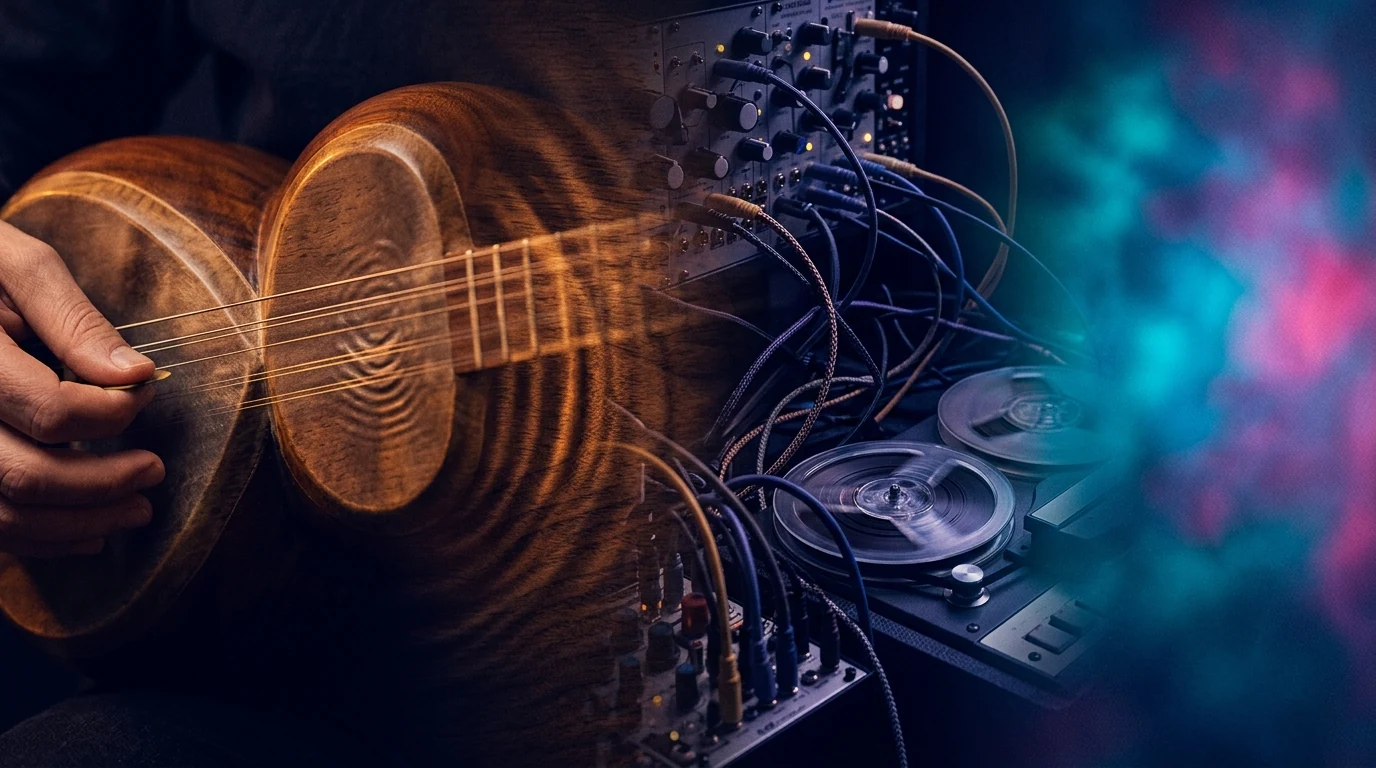
A contemporary translation should not copy a plectrum pattern and then add a generic “desert” preset. It should ask what the pattern is doing and move that function into a new production environment.
Five translation layers for the ReyTune series
Source anchor
Name the dastgah, gusheh, regional practice or reference recording. If the source is interpretive, say so.
Rhythmic cell
Describe the stroke pattern, meter, accent and permissible variation before choosing a sound.
Modal contour
Keep the centre, characteristic tones, approach notes and return audible in the lead material.
Rock body
Use bass, drums, guitar, santur, frame drum or synthesis to give the rhythm physical weight.
Psychedelic field
Transform repetition through saturation, filtering, delay, register and stereo depth—not through decoration alone.
The framework is a production tool, not a claim that a hybrid track is an untouched traditional performance.
How can AI work with a rhythmic framework?
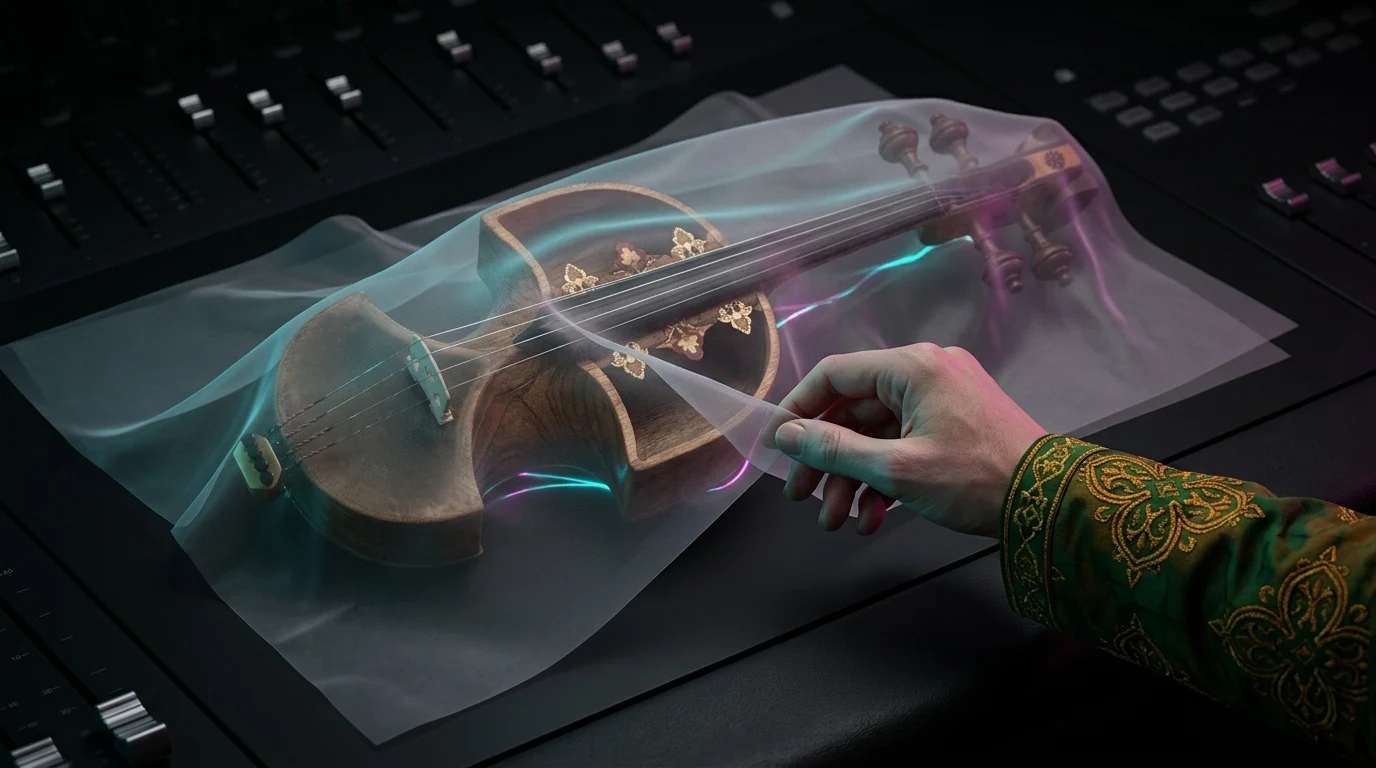
Current music-generation research is beginning to move beyond the assumption that one Western-tempered dataset can represent every musical culture. The IRMA Dataset combines symbolic MIDI representations, phrase-level audio–MIDI alignment, musicological transcriptions and comparative theoretical metadata for Iranian classical repertories. A 2026 Persian MusicGen preprint likewise argues that models trained primarily on Western music face difficulties with Persian tonalities, dastgah systems and rhythmic structures, and tests domain-specific fine-tuning on a large Persian-music collection. These resources are promising, but neither a dataset nor a model automatically supplies lived cultural interpretation. (IRMA Dataset; Persian MusicGen preprint)
AI and Persian rhythmic forms: a practical summary
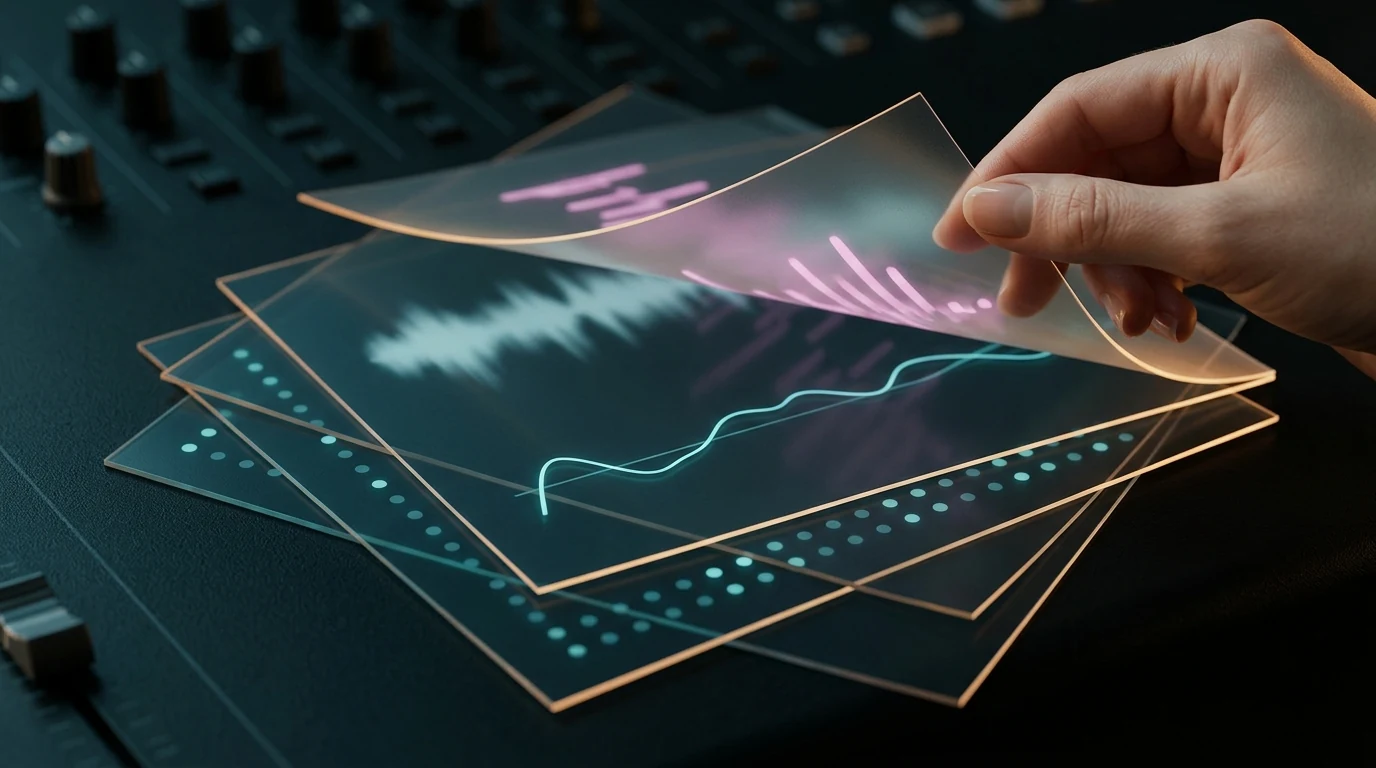
| Dimension | ReyTune position |
|---|---|
| AI can assist | Segment recordings, estimate pulse, compare phrase contours, generate texture variations, test arrangement density and create searchable annotations. |
| AI struggles with | Microtonal intention, lineage, performance etiquette, the difference between a convincing return and a statistically likely note, and the lived meaning of tarab. |
| Best use | Human-led variation, archive support, educational comparison and responsive accompaniment that remains subordinate to a musical director. |
| Key risk | A polished “Persian-sounding” loop that has no traceable source, no modal grammar and no meaningful long-range form. |
ReyTune’s production protocol

For each track in the forthcoming chaharmezrab-psychedelic series, the working document should contain a source card before any generative session begins:
- Source: name the tradition, region, dastgah or reference recording and record what is documented versus interpretive.
- Cell: notate or describe the rhythmic unit, accents, tempo range and allowable variation.
- Contour: mark the modal centre, characteristic tones, approach gestures and return points. Do not treat a scale diagram as the whole source.
- Body: choose the contemporary instruments and production weight—bass, drum, guitar, santur, frame drum, synth or field texture.
- Transformation: define what repetition changes: register, saturation, density, stereo depth, harmony, timbre or duration.
- Human pass: listen for narrative, proportion, intonation and cultural overstatement with a musician or qualified reviewer.
- Disclosure: document AI assistance, source material, permissions and the difference between inspiration and performance.
Tradition · Reference recording · Dastgah/gusheh or regional context · Meter/cell · Modal centre · Characteristic inflections · Instrumentation · Psychedelic transformation · Human reviewer · Rights/disclosure status.
The forthcoming series: a working architecture
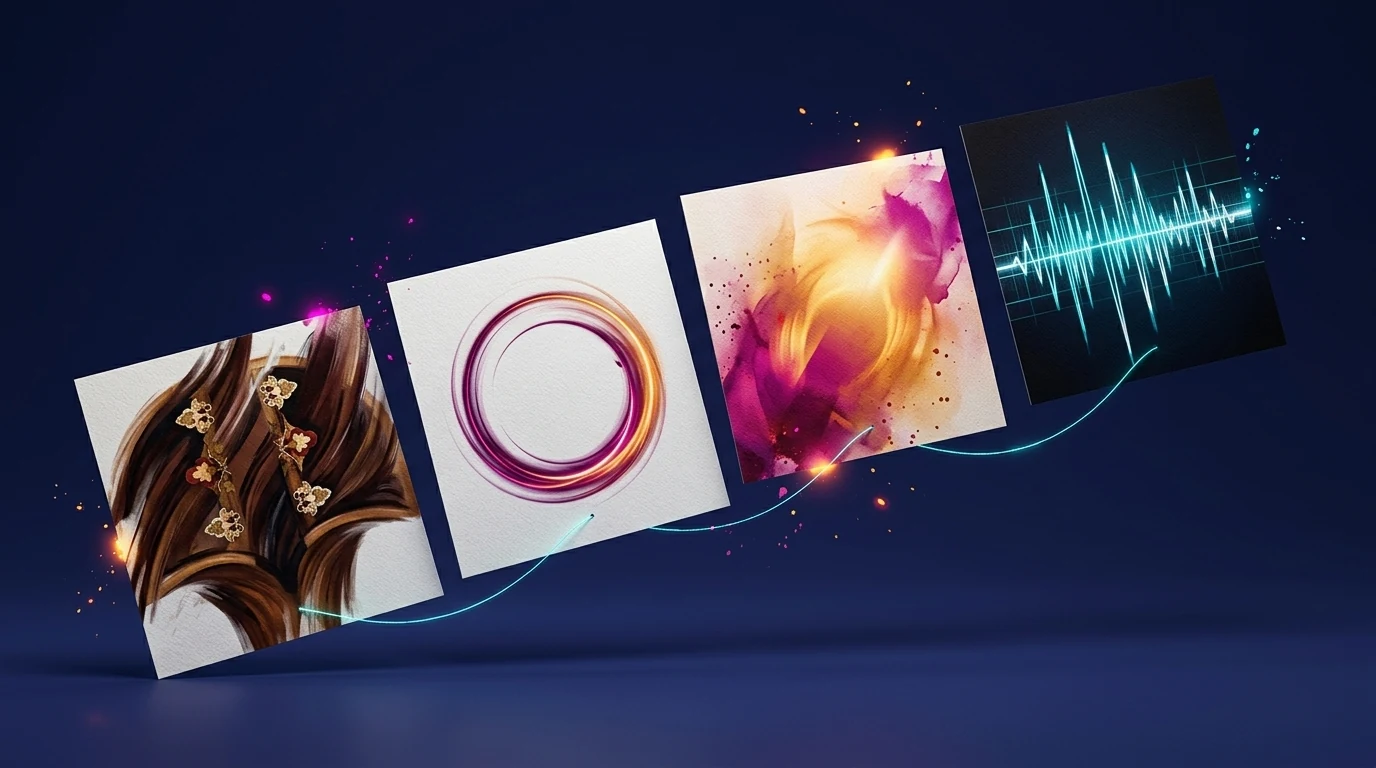
The following names describe a production architecture, not released ReyTune catalogue entries. They can change after the first listening tests.
Four Strokes / Chaharmezrab
A compact, high-motion piece. The repeated cell stays recognisable while guitar, santur-like attacks and electronic space gradually change its meaning.
Function: ignition and entry.
Reng After Fire
A brighter, more communal movement in which the accumulated tension becomes a legible pulse. The aim is lift without generic “world music” shorthand.
Function: release and bodily participation.
Mythic Return / Future Pulse
A longer-form coda that carries the rhythmic intelligence into a cinematic, spacious field while keeping the source relationship visible.
Function: memory, scale and return.
How can a hybrid remain culturally responsible?
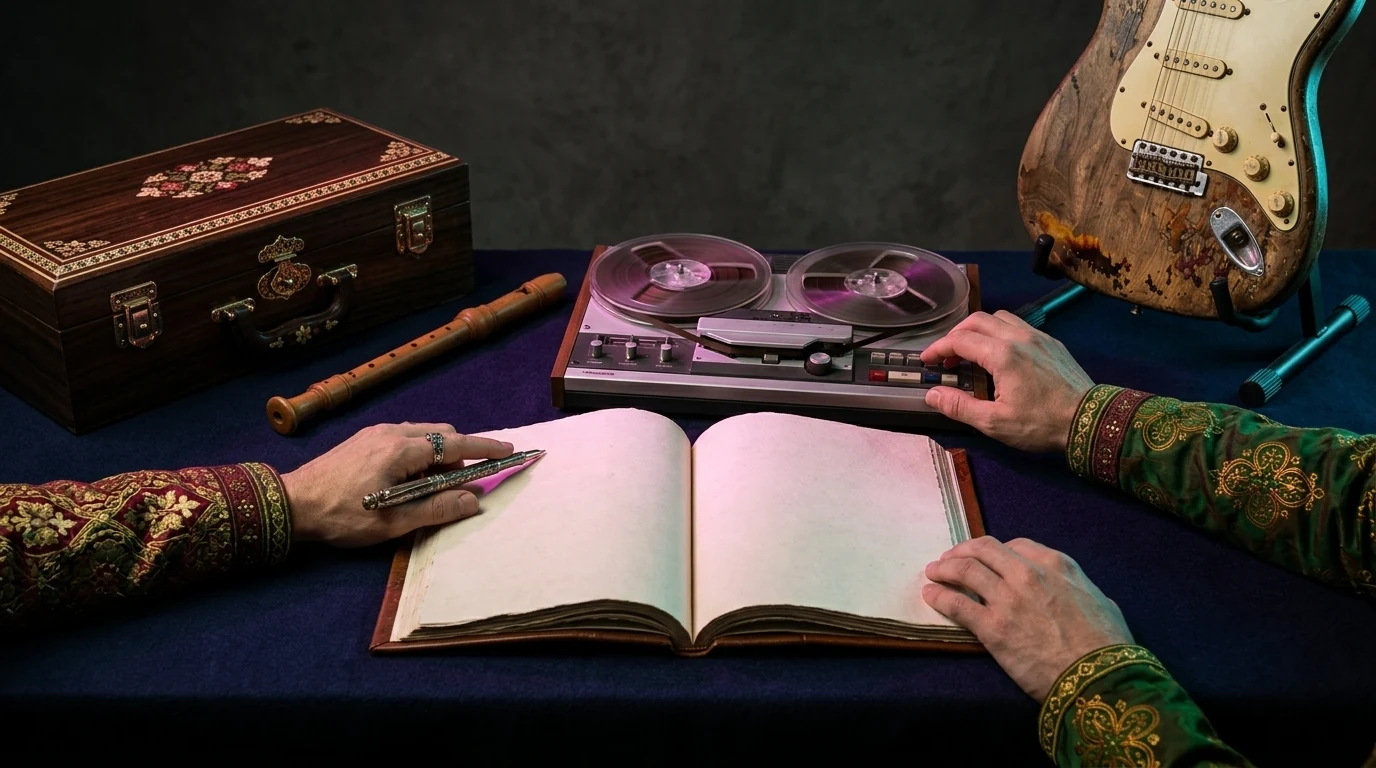
Cultural responsibility does not require freezing a form in the past. It requires specificity, traceability and proportion. A ReyTune track may simplify, amplify, combine or transform a source. The ethical obligation is to name what changed.
- No ancient reconstruction claim: describe ancestral or mythic inspiration as artistic framing unless a documented historical source supports a stronger claim.
- No scale reductionism: a pitch collection or “Persian” tuning does not reproduce a dastgah, gusheh or performance tradition.
- No single-Persian-style shortcut: identify regional and modal sources rather than presenting Iran or Persia as one undifferentiated sound.
- No mood essentialism: reng is not automatically happy, and tarab is not a fixed emotion label.
- No documentary ambiguity: generated images, reconstructed scenes and AI-assisted audio must be identified as such.
- No unlicensed extraction: recordings, transcriptions and training materials require rights checks, attribution and consent where applicable.
The strongest version of this project is not the one that claims to have made an ancient sound. It is the one that lets listeners hear a relationship: a documented rhythmic idea, a contemporary transformation, a human editorial choice and a transparent account of the tools involved.
Conclusion: motion is memory

Chaharmezrab teaches us that repetition can be athletic, precise and alive. Reng teaches us that a composed pulse can carry social lightness without losing modal identity. Tarab reminds us that neither form becomes meaningful through labels alone. Meaning appears when the music’s timing, emphasis, texture and return reach a listener in a particular moment.
That is the opportunity for Persian psychedelic production in the AI era. We can use machines to compare patterns, extend textures, test arrangements and build new instruments. We can use contemporary rock and electronic production to change the scale of time. But the work remains ours: to choose the source, protect its context, make the transformation audible and decide whether the result has a reason to return.
ReyTune is not trying to make an ancient Persian recording with AI. It is asking how an old rhythmic intelligence can survive inside a new instrument, a new production language and a new listening culture.
Where should you start?
Begin with one chaharmezrab reference and listen for the engine before analysing the mode. Then hear a reng and notice what changes when the music becomes lighter and more collective. Finally, return to a ReyTune release or long-form session and ask where its repetition earns a new meaning.
Continue with ReyTune’s guide to Persian psychedelic rock for the production language, and Can AI Understand Persian Music? for the cultural and computational boundary.
Chaharmezrab, Reng and Persian Psychedelic Music Glossary
- Chaharmezrab
- A fast, metric, usually instrumental Persian rhythmic genre associated with repeated plectrum patterns, melodic return and virtuoso motion. Reng
Frequently Asked Questions
Is chaharmezrab an ancient Persian music form?
Chaharmezrab belongs to the documented traditional and classical repertoire, but it should not be described as a direct surviving recording of ancient Persian music. ReyTune uses it as a living rhythmic framework for a contemporary interpretation. Does chaharmezrab always mean four beats?
Public Evidence Ledger
| Claim | Evidence | Type | Confidence | Reviewed |
|---|---|---|---|---|
| Chaharmezrab is a traditional rhythmic instrumental genre associated with plectrum patterns, fast metric motion, repetition and later adaptation across instruments | Source | scholarly | high | 2026-08-24 Reng is a composed rhythmic piece of light character associated with dance music and often placed at the end of a classical performance sequence |
Evidence & Sources
- ČahārmeżrābEncyclopaedia Iranica · Jean During Iran xi. Music
The next movement is already in motion
Follow ReyTune as Persian rhythmic memory moves through psychedelic production and new AI-era instruments.

Written by