
A Deep Exploration — Updated June 2026 · ~12 min read
Introduction: When a System Claims to Understand
When people ask whether artificial intelligence can “understand” music, they often mean more than pattern recognition. They are asking whether a system can perceive structure, anticipate motion, respond appropriately in context, and engage with meaning. That definition becomes especially demanding in culturally dense traditions such as Persian music, where musical form is inseparable from heritage, pedagogy, performance etiquette, and a refined vocabulary of emotion.
For AI, “understanding” can be unpacked into several layers:
- Acoustic and symbolic comprehension: identifying pitches, intervals, motifs, meters, and ornamentation; converting audio into a representation (notation, pitch contours, embeddings).
- Stylistic competence: generating or continuing phrases that sound plausible within a given dastgah and its gusheh repertoire; respecting idiomatic cadences and melodic grammar.
- Performance intelligence: reacting in real time, shaping dynamics and timbre, and demonstrating musically coherent “decisions.”
- Cultural-semantic interpretation: relating a phrase not only to its modal function, but to the lived context that gives it weight: lineage, setting, poetic association, and the performer’s intent.
AI can do portions of the first three with increasing sophistication. The fourth—cultural-semantic interpretation—remains the most contested, because it asks whether computation can approximate meaning without lived experience. Persian music exposes this boundary clearly, because it is built not only on notes and rhythms, but on memory, refinement, and situational expression.
Quick Answer
AI can partially understand Persian music at a structural level: it can analyze pitch movement, detect patterns, model timbre, and generate stylistically plausible phrases. However, Persian music is shaped by dastgah, gusheh, radif, microtonality, improvisational memory, and cultural meaning. AI can assist with analysis, preservation, and hybrid performance — but it cannot fully replace lived cultural interpretation.
- Why Persian music challenges AI systems more than surface-level style imitation
- How dastgah, gusheh, microtonality, improvisation, and tarab shape musical meaning
- Where AI can help with preservation, education, analysis, and hybrid performance
- Why cultural stewardship matters when technology enters heritage music
What You’ll Learn
- Why Persian music challenges AI systems more than surface-level style imitation
- How dastgah, gusheh, microtonality, improvisation, and tarab shape musical meaning
- Where AI can help with preservation, education, analysis, and hybrid performance
- Why cultural stewardship matters when technology enters heritage music
AI and Persian Music: Summary
A concise summary of what AI can and cannot do with Persian music.
| Dimension | Details |
|---|---|
| ✅ AI Can | Detect pitch contours, classify timbre, segment recordings, generate stylistic phrases, and transcribe melodies. |
| ❌ AI Struggles With | Tarab, lineage awareness, poetic association, cultural intent, and improvisational memory. |
| 💡 Best Use Cases | Cultural preservation, music education tools, computational musicology, and hybrid human-AI performance. |
| ⚡ Key Risk | Flattening heritage into aesthetic wallpaper — reducing centuries of tradition to surface-level texture. |
The Essence of Persian Music: Why It Resists Simple Modeling
The Dastgah System as an Aesthetic Grammar
Persian classical music is frequently organized around the dastgah system, a modal framework that is both theoretical and practical. A dastgah is not merely a scale; it is a constellation of melodic expectations, characteristic tones, tension-release pathways, and culturally recognized “states” that performers learn through long apprenticeship. (UNESCO, Intangible Cultural Heritage of Humanity)
Within each dastgah sits a repertoire of gusheh—melodic pieces or modules that act like landmarks. Gusheh provide:
- Motivic identities (recognizable melodic shapes),
- Pivot points (where modulation or emphasis shifts),
- Narrative progression (a sense of journey rather than repetition).
For a human musician, internalizing gusheh is less like memorizing a list and more like absorbing a language: you learn what belongs, what is daring, what is tasteful, and what is inappropriate in a given moment.
Microtonality and the Precision of Intonation
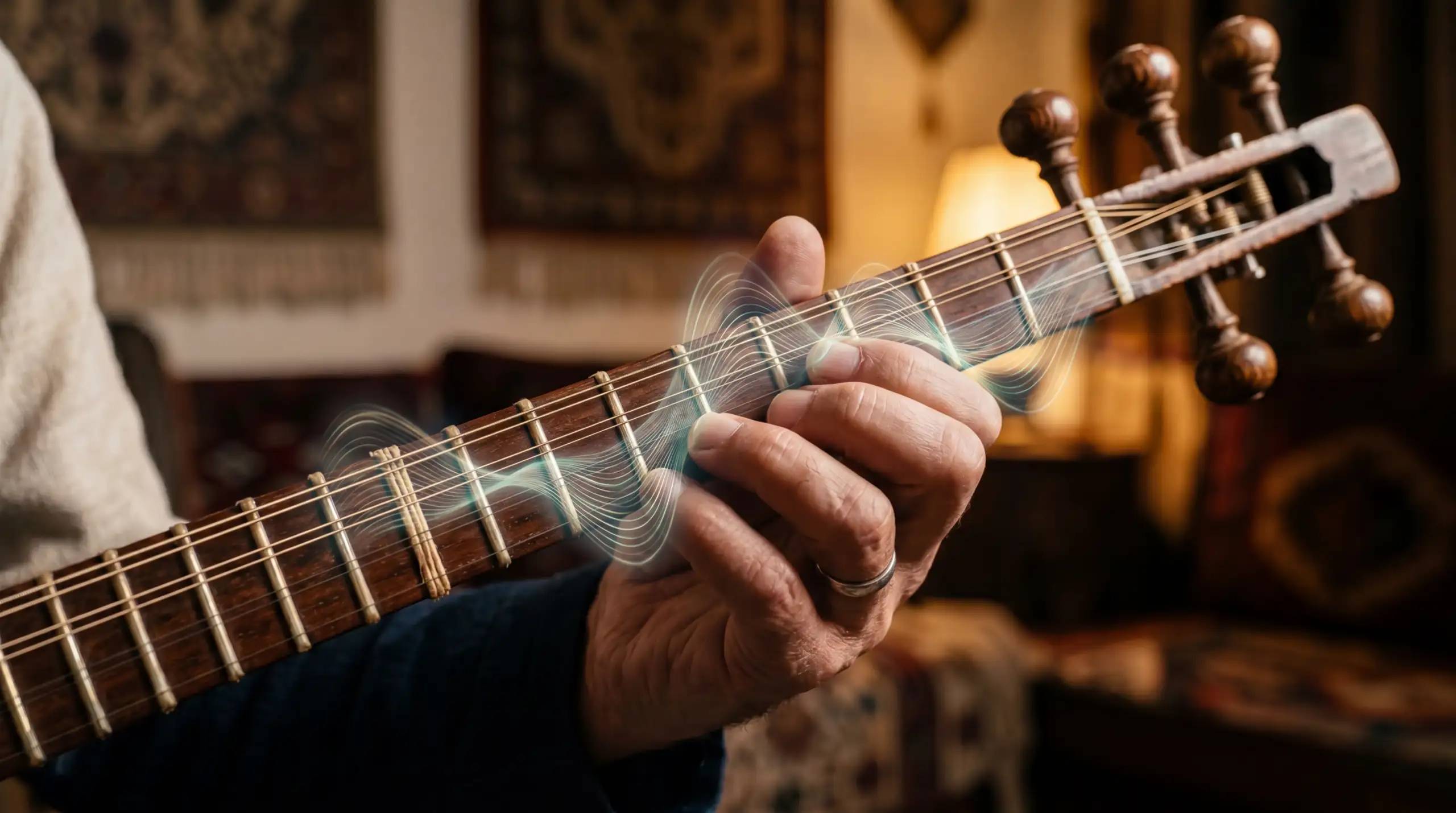
A central challenge in Persian sound is microtonal nuance—intervals that do not align cleanly with 12-tone equal temperament. Even when musicians use approximations, the expressive role of intonation remains central. Subtle pitch shading communicates character and direction; it can distinguish a phrase as credible or superficial. (Radif Corpus Project)
For AI systems trained largely on Western-tempered datasets, microtonality introduces multiple problems:
- Representation: how to encode pitch beyond semitone bins without losing culturally meaningful distinctions.
- Perception: how to detect and track micro-interval motion in expressive, ornamented performance.
- Generation: how to produce microtonal contours that feel intentional rather than random drift.
Rhythm: From Measured Cycles to Elastic Time
Persian music includes both metered and unmetered domains. Certain rhythmic structures can be complex and cyclical, but a defining feature is also elastic timing—rubato, breath-shaped phrasing, and expressive stretching. A machine can learn statistical timing distributions, yet Persian performance often depends on situational pacing: the room, the ensemble, and the emotional arc.
Improvisation as a Non-Linear, Human-Learned Process
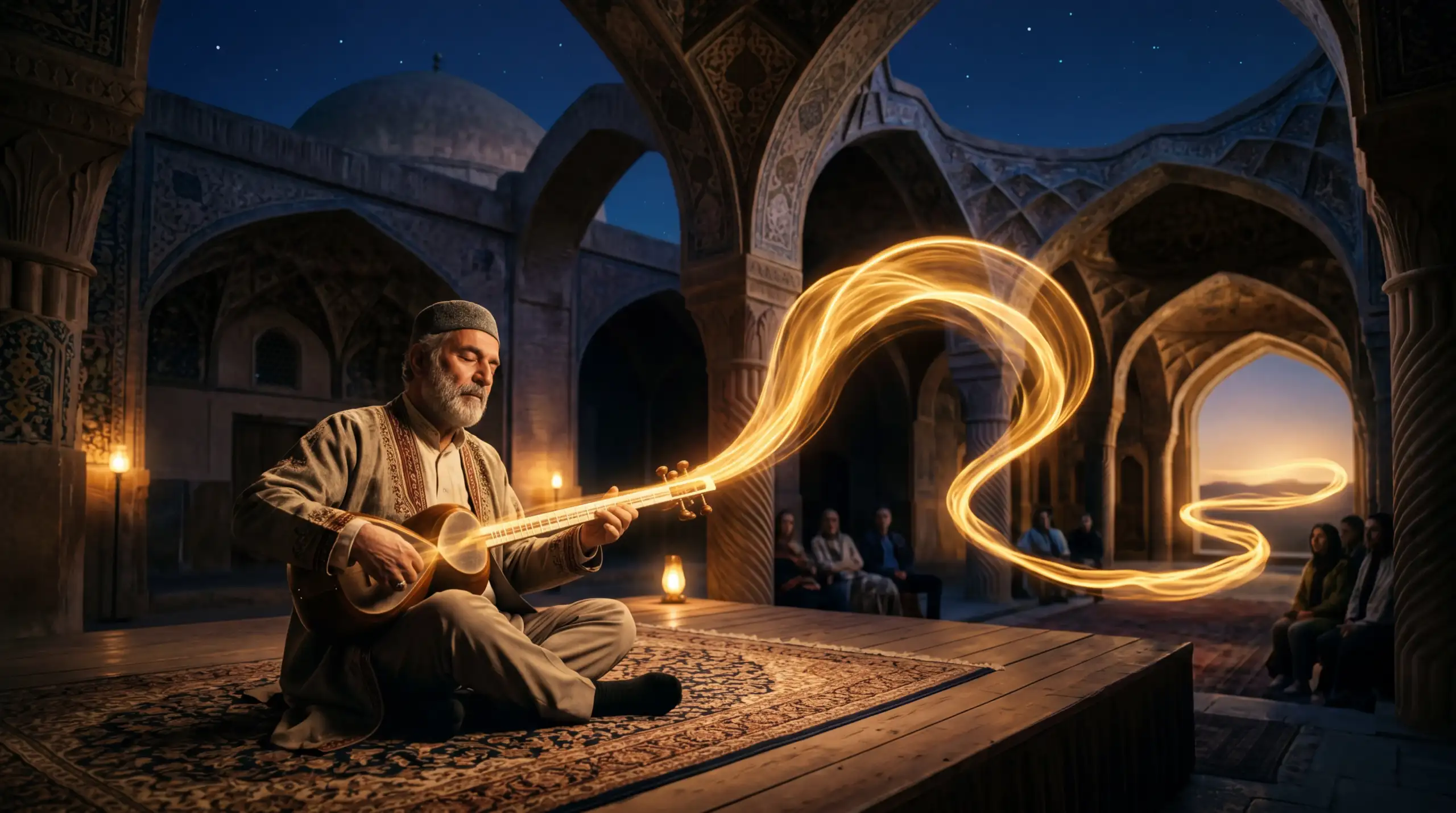
Improvisation in Persian music is not a free-for-all. It is guided by a musician’s deep familiarity with radif (the transmitted repertoire), personal taste, and the social logic of performance. The musician’s improvisation is an act of curation and transformation—selecting gusheh references, varying them, and connecting them with meaningful transitions.
This is precisely where many AI systems look impressive yet fragile: they can produce fluent local continuations, but struggle with long-range musical narrative and culturally grounded constraint.
Tarab: Emotional Resonance in Live Performance
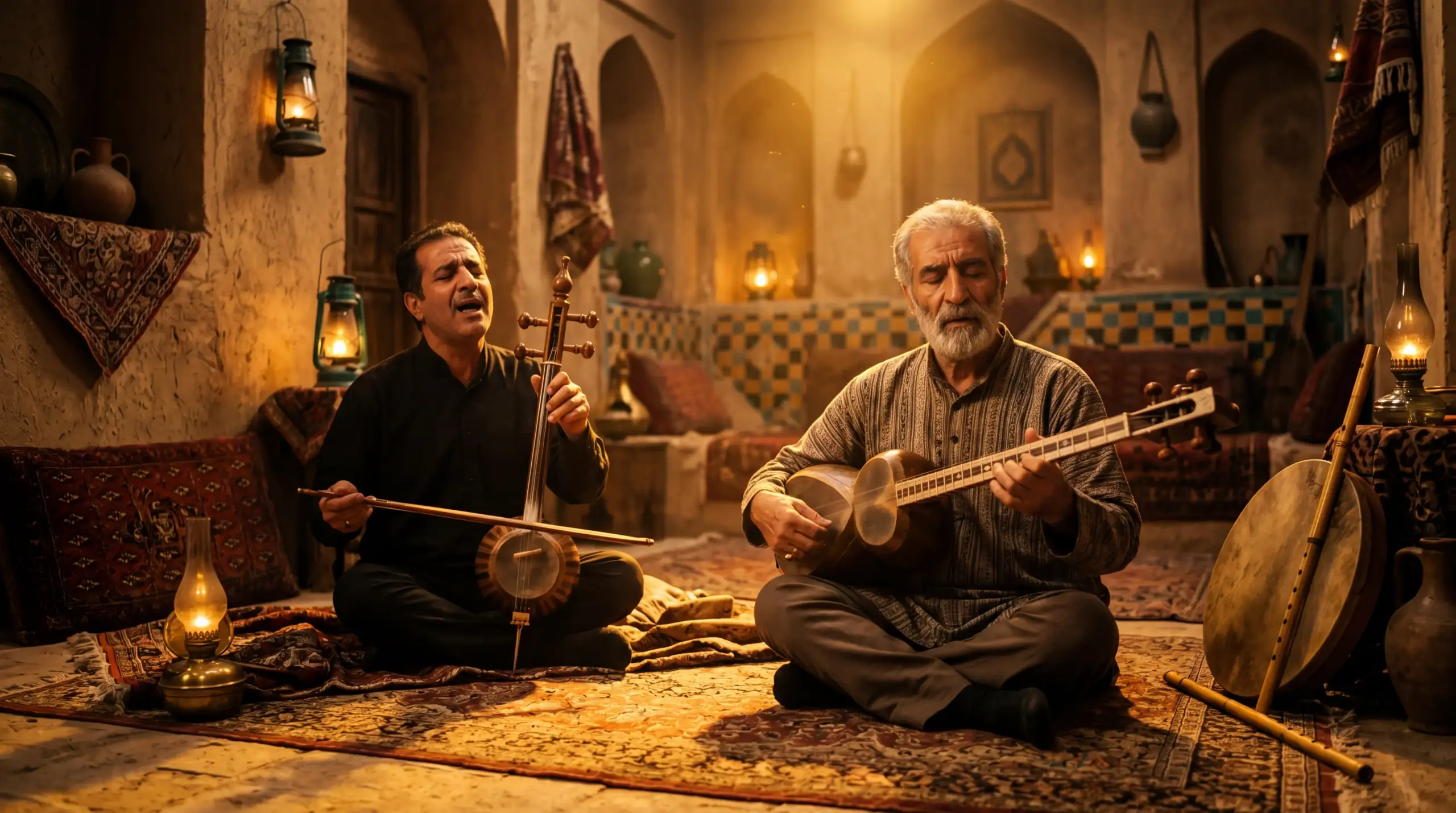
A crucial dimension is tarab, often described as a state of musical ecstasy or deep emotional engagement. Tarab is not merely “sad” or “happy.” It is a socially and culturally understood intensity that can emerge through timbre, pacing, melodic emphasis, and the performer’s responsiveness.
“AI can model acoustic correlates of intensity, but tarab is not reducible to a single feature. It is an emergent relationship among performer, audience, memory, and moment.“
Heritage Context: Persian Music as a Living Archive
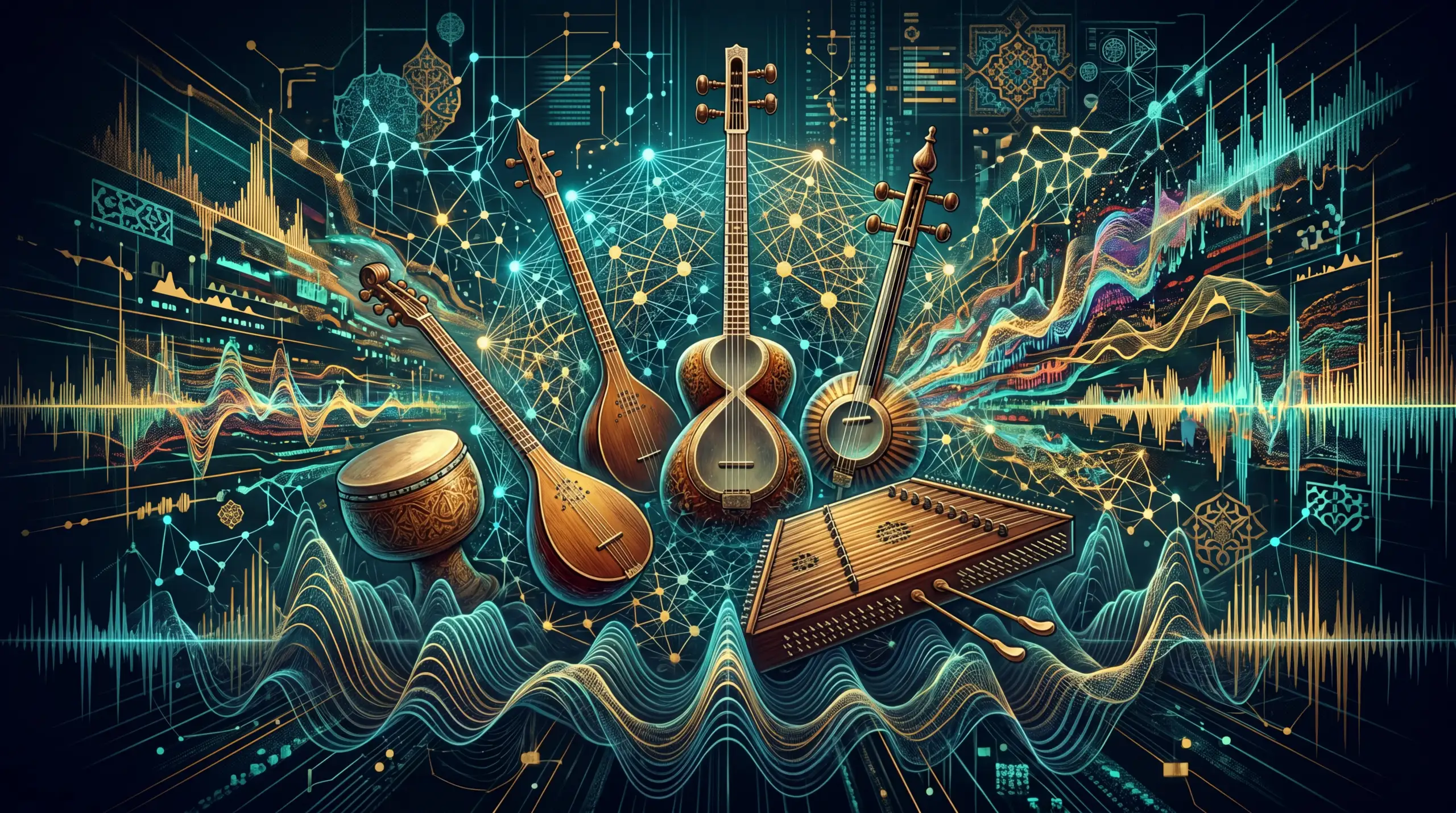
Persian music is a heritage art form with lineages, instruments, and aesthetics that carry centuries of cultural memory across West Asia. Instruments such as tar, setar, santur, and kamancheh are not just sound sources; they embody technique traditions, timbral ideals, and social meaning.
Any claim that AI “understands” Persian music must therefore address a central reality: much of what matters is not contained in the waveform alone.
AI’s Current Musical Prowess: What Machines Can Do Today
Generation: Stylistic Imitation at Scale
Modern generative models can create music that resembles a target style, especially when trained on large audio corpora. They excel at:
- Surface plausibility: producing phrases that sound stylistically coherent at a local level.
- Texture synthesis: generating timbral layers that evoke particular ensembles or production aesthetics.
- Prompted adaptation: aligning output with high-level descriptors (tempo, mood, instrumentation).
However, generation success in culturally rich music depends on dataset quality and labeling. If training data lacks representative Persian performances and accurate modal annotation, the model will learn a diluted “global world-music” average rather than Persian specificity.
Analysis and Transcription: From Audio to Symbols
AI has advanced in pitch tracking, source separation, and transcription, especially for monophonic lines. Yet Persian music stresses these systems because:
- Ornamentation is continuous and fast,
- Pitch centers may be fluid,
- Microtonal intervals challenge standard note grids,
- Expressive timbre can blur pitch estimates.
Still, analysis tools can be extremely valuable as assistive systems: identifying phrase boundaries, estimating pitch trajectories, or cataloging ornamentation patterns across recordings.
Performance: Real-Time Interaction and Accompaniment
Interactive AI can follow tempo, react to cues, and generate accompaniment. In Persian contexts, real-time collaboration demands sensitivity to:
- unmetered sections,
- intentional timing rubato,
- modal transitions,
- idiomatic cadences.
Today’s systems can be made useful in constrained settings (fixed tempo, limited mode palette), but struggle with the open-ended nuance of advanced performance practice.
Emotional Modeling: Prediction vs. Meaning
AI can correlate acoustic features with perceived affect (tension, brightness, intensity), and it can cluster styles by timbral similarity. But in Persian music, emotional meaning is often encoded culturally, not purely acoustically. A phrase can carry weight because of its placement, lineage, or poetic association, not just because it is slow or minor-sounding.
Why Persian Music Is a Stress Test for AI
1) Microtonality Is Not a Minor Detail
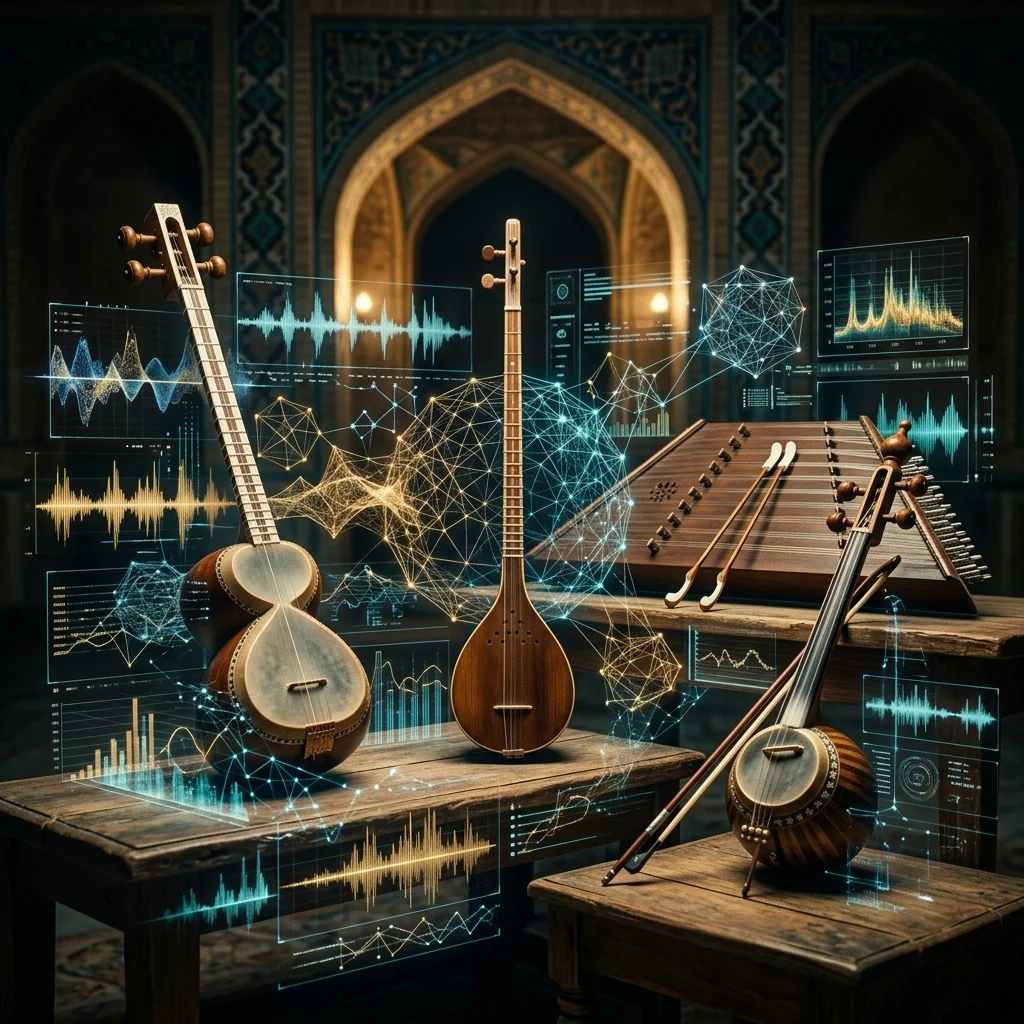
Microtonality in Persian sound is not an “extra,” it is a core grammar. Many AI pipelines implicitly assume 12-tone temperament at the representation level. Even when models operate on audio directly, evaluation often uses tempered metrics or Western-centric expectations.
To engage Persian music seriously, AI must treat pitch as a continuous expressive space, while still recognizing culturally meaningful anchors.
2) Improvisation Requires Long-Range Musical Memory
A persuasive Persian improvisation is not only a sequence of plausible phrases. It is a guided journey through modal regions and gusheh references. This implies:
- remembering what has been played,
- shaping contrast and return,
- balancing novelty with recognizability.
Most generative models are strongest at short-range coherence. Without explicit structure constraints, they risk producing “pretty” but aimless output—competent texture without narrative.
3) Modal Identity Can Be Subjective and Contextual
Even expert musicians may debate the boundaries of a mode or the interpretation of a phrase in performance. Modal identity can depend on emphasis, intonation, and contextual placement. AI systems prefer crisp labels. Persian practice often lives in nuanced ambiguity.
4) Cultural Context Is Not in the Signal
The philosophical hurdle is straightforward: AI can model correlations, but correlation is not comprehension. A model can predict what note comes next based on statistical learning, but does it know why a certain gesture is meaningful in a West Asian cultural setting?
If “understanding” requires lived cultural participation, then AI cannot fully understand in a human sense. If “understanding” means producing and analyzing musically credible structures, then AI can partially understand—especially as a tool in human hands.
5) The Risk of Flattening Heritage into Aesthetic Wallpaper
A common failure mode is “heritage as texture”: using Persian instruments or scales as exotic color while ignoring the internal logic of dastgah and radif. This is not only musically shallow; it raises ethical concerns about extraction and misrepresentation.
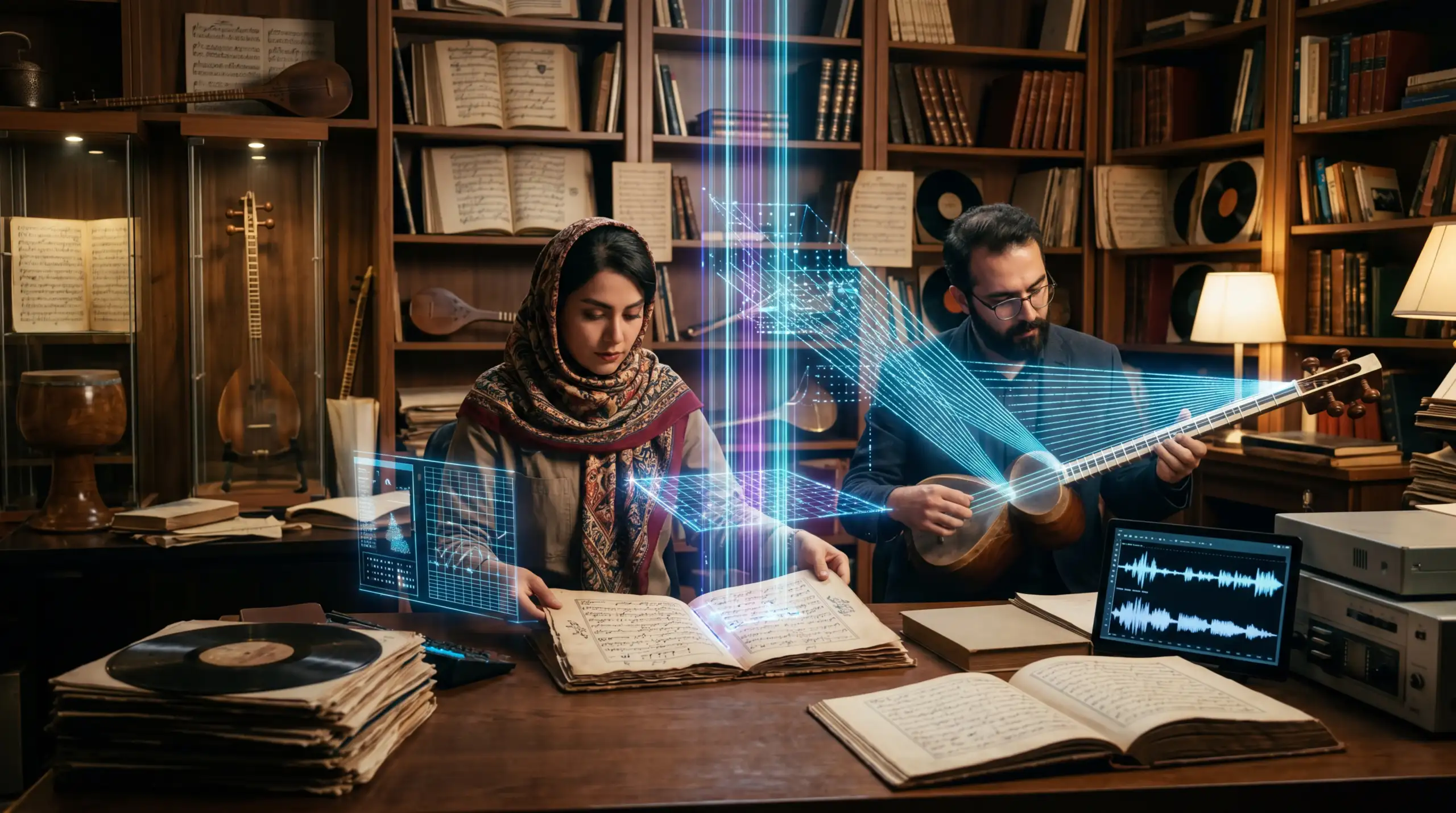
The following demo illustrates how AI-assisted restoration can reduce tape hiss and clarify archived Persian music recordings while preserving the character of the original performance.
Opportunities and Future Trajectories: Where AI Can Truly Help
Preservation and Archiving: Building Searchable Cultural Memory
AI can become an accelerant for preservation when guided by musicians and scholars: (IRMA Dataset)
- Audio restoration and cleaning for archival recordings,
- Segmentation of long performances into navigable sections,
- Pitch contour indexing for searching related phrases,
- Metadata enrichment (instrument, performer, region, mode, gusheh candidate).
Done respectfully, AI can make Persian heritage more discoverable and teachable without replacing the human lineage that sustains it.
This is a conceptual restoration demo for educational purposes, not a replacement for archival musicology or human restoration judgment.
Musicology and Comparative Analysis
AI can support musicologists by revealing patterns across corpora:
- how particular gusheh are realized across performers,
- variations in intonation practices,
- stylistic fingerprints of tar vs. setar phrasing,
- evolution of ornamentation over decades.
These applications do not require the machine to “feel” tarab; they require robust measurement aligned with Persian musical realities.
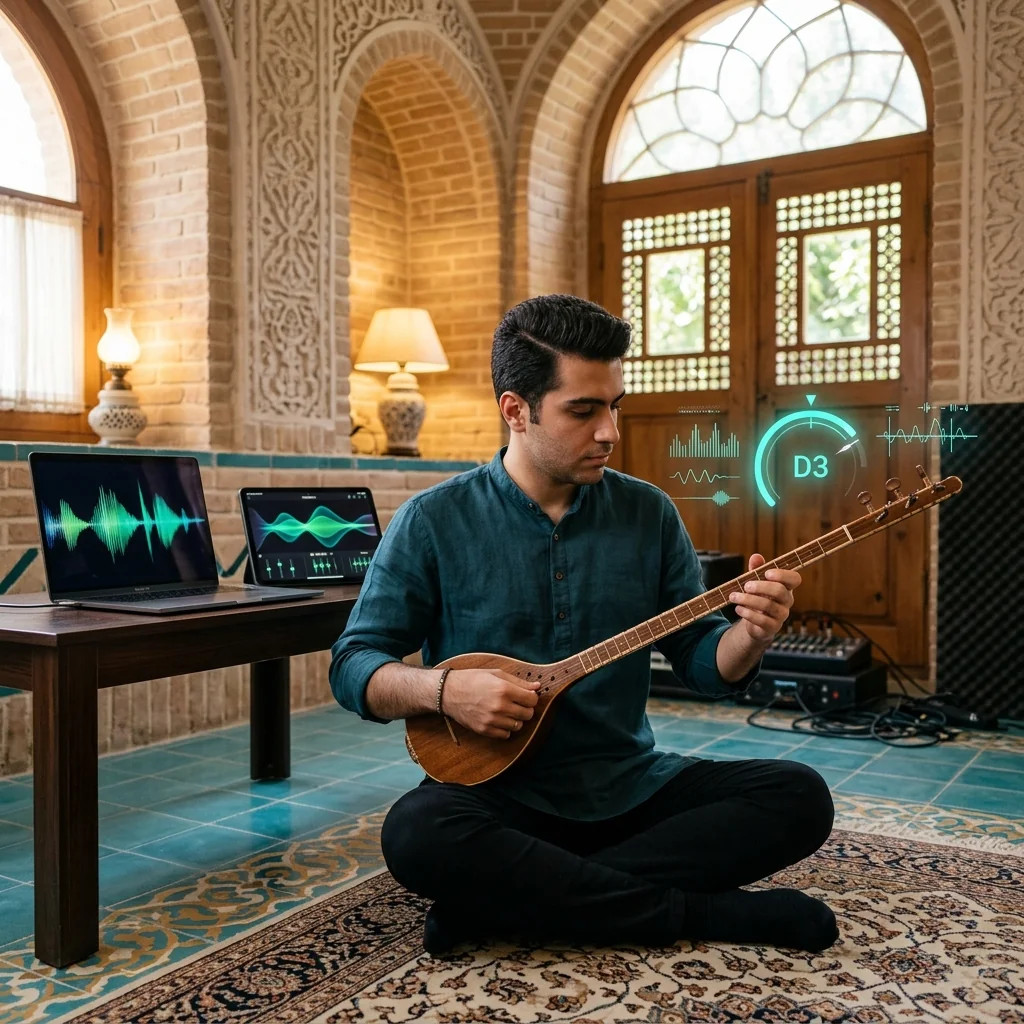
Practice Tools for Musicians
AI-assisted education can be transformative if designed with cultural integrity:
- Intonation coaching for microtonal targets,
- Call-and-response training within a constrained dastgah,
- Improvisation scaffolds that suggest plausible transitions, not finished solos,
- Radif learning aids with slow-down, segmentation, and phrase comparison.
Here the ideal is not automation, but augmentation—supporting the apprentice process that remains central in Persian pedagogy.
New Performance Formats: Human-Led Hybrid Improvisation
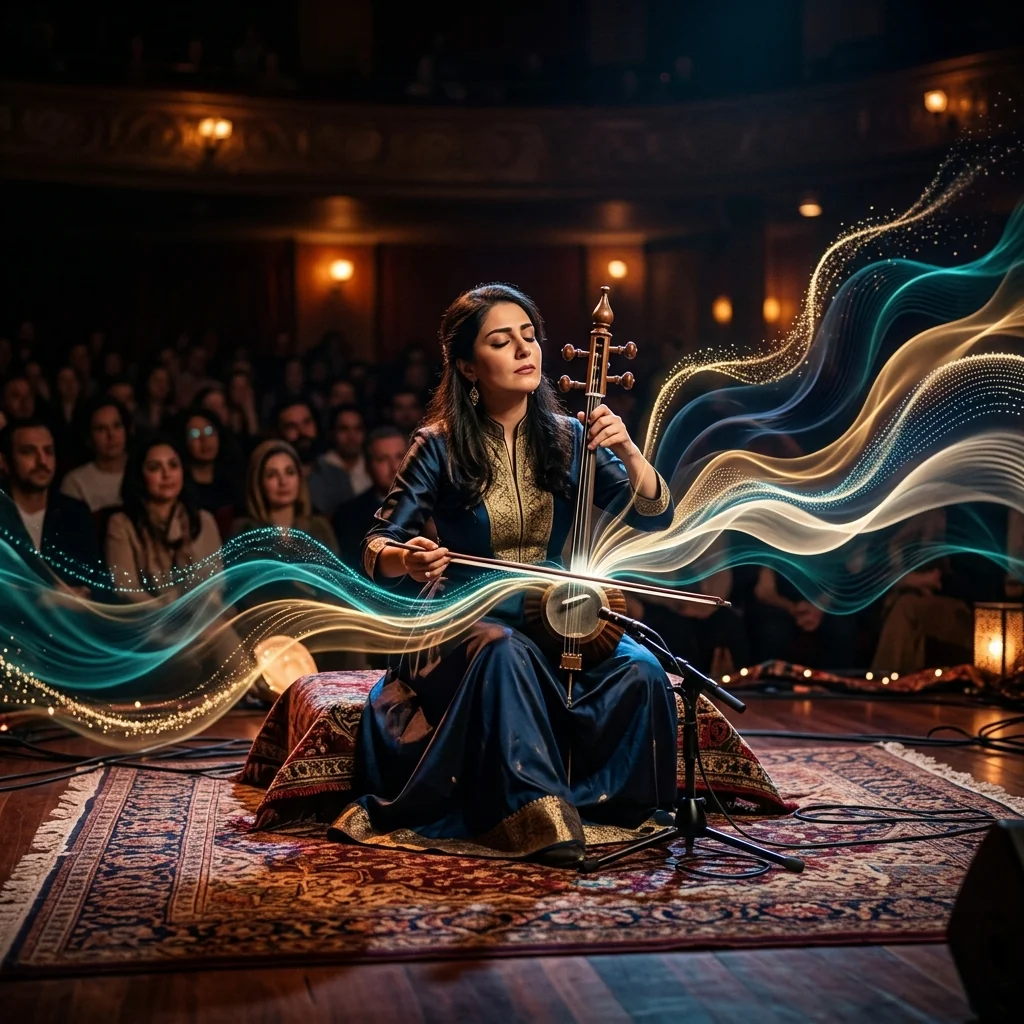
The most promising future is not AI-as-composer but AI-as-responsive instrument. Imagine systems that:
- listen to a kamancheh line,
- infer the local modal center,
- generate subtle drones, textures, or rhythmic shadows,
- remain subordinate to the human performer’s direction.
This preserves authorship while expanding the performance palette.
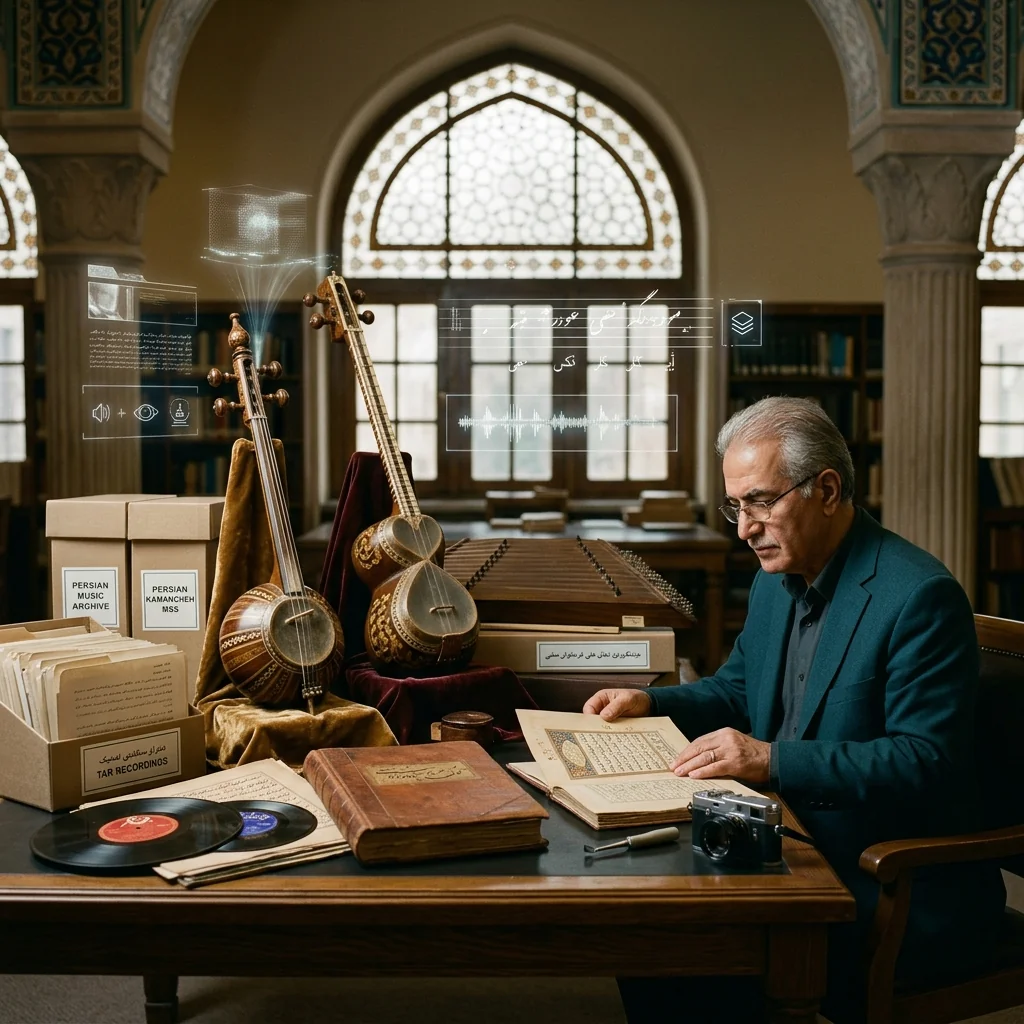
Ethical Design: Guardrails for Cultural Integrity
As AI engages Persian heritage, ethical practice becomes non-negotiable:
- Consent and licensing of recordings used for training,
- Attribution and lineage transparency where possible,
- Avoiding homogenization (one “Persian style” as a monolith),
- Community participation in dataset curation and evaluation.
A culturally respectful system is not only more ethical; it is also more accurate.

Conclusion: Can AI Understand Persian Sound?
AI can already detect patterns, generate plausible phrases, and assist analysis in ways that can meaningfully support Persian music—especially in preservation, education, and research. Yet Persian sound is a demanding domain because it is built on microtonal precision, improvisational narrative, and cultural meaning that extends beyond the audio signal.
So the answer depends on what “understanding” means.
If understanding is structural competence, AI can achieve partial and growing success—particularly with better datasets, microtonal representations, and human-in-the-loop design.
If understanding is cultural interpretation, the machine remains an outsider. It can model traces of meaning, but it does not participate in heritage as lived experience.
ReyTune’s position sits precisely in this productive tension: using advanced technology to engage Persian legacy with rigor, not as aesthetic garnish but as a living system of knowledge. The future will not be AI replacing Persian musicians. It will be AI becoming a new class of instrument and archive—one that, when shaped by West Asian cultural stewardship, can deepen access, preserve nuance, and open new frontiers for contemporary influence without compromising heritage.
Glossary: Key Terms in Persian Music and AI
| Term | Definition | Why it matters for AI |
|---|---|---|
| Dastgah | A Persian modal system that shapes melodic identity, movement, and emotional character. | AI must model more than scale degrees — dastgah encodes aesthetic grammar. |
| Gusheh | A melodic unit or motif inside the radif tradition, each carrying specific modal and emotional weight. | Helps AI understand phrase-level memory and contextual meaning. |
| Radif | The transmitted repertoire at the heart of Iranian classical music, passed from master to student over generations. | Essential for training data, annotation frameworks, and cultural preservation. |
| Tarab | A culturally understood state of musical intensity, ecstasy, or deep emotional resonance. | Cannot be reduced to acoustic features — requires lived cultural experience. |
| Microtone | Intervals smaller than a Western semitone, central to Persian intonation and expressiveness. | Standard MIDI and Western tuning systems cannot represent these intervals accurately. |
ReyTune’s Position on AI and Persian Music
- AI should not replace Persian musicianship. The tradition’s depth comes from lifetimes of learning, lineage, and lived performance.
- AI can become an archive, assistant, and responsive instrument — supporting musicians rather than substituting them.
- Persian sound should be treated as a living knowledge system, not as exotic texture for content generation.
- Any AI use in Persian music must respect lineage, consent, licensing, and cultural context.
ReyTune is a Persian-rooted experimental music project exploring AI-era sound, cultural memory, and hybrid performance. Our debut track ‘Bito Besar Nemishavad’ transforms Rumi’s Ghazal 553 into a modern electronic anthem — bridging tradition and innovation.
Frequently Asked Questions
Can AI fully understand Persian music?
Why is dastgah difficult for AI models?
What is the difference between radif and dastgah?
Can AI generate Persian classical music?
Why does microtonality matter in Persian music?
What role can AI play in preserving Persian music?
Is AI a threat to cultural music traditions?
How does ReyTune approach Persian sound in the AI era?
✍️ Editorial Note
This article reflects ReyTune’s perspective as a Persian-rooted experimental music project exploring AI-era sound, cultural memory, and hybrid performance. It is informed by published research in computational musicology, UNESCO cultural heritage documentation, and ongoing creative practice at the intersection of tradition and technology. Content is reviewed and updated regularly to reflect new developments in AI music research.
Update History
| Major update: expanded sections on microtonality, radif datasets, AI preservation. Added glossary, FAQ, evidence sources, and structured data for generative search visibility. | |
| Initial publication: comprehensive exploration of AI and Persian music covering dastgah, gusheh, improvisation, tarab, and ethical design. |
Evidence and Sources
📚 Evidence Notes
- UNESCO recognizes the Radif of Iranian music as Intangible Cultural Heritage — a core traditional repertoire of Iranian classical music and the essence of Persian musical culture.
- Computational musicology research has introduced symbolic and structured datasets for Iranian classical music, including radif-centered corpora with 228 pieces, quarter-tones, and hierarchical modal structures (Radif Corpus, arXiv).
- The IRMA Dataset presents radif as a structured repertoire of modal-melodic units for pedagogy and performance — useful for transcription, generation, and cultural heritage preservation.
- These datasets demonstrate why Persian music is not only a cultural topic but a computational challenge involving pitch precision, non-metric structure, and metadata-rich annotation.
Continue the ReyTune Experience
Explore how Persian-rooted sound, cultural memory, and AI-era production meet in ReyTune’s music.
 Listen on Spotify
 Watch on YouTube
